
Your website has great UX. It loads quickly, guides the customer step-by-step through the purchase process, and looks professional.
But more and more often, the first visitor to your website isn’t human - it’s an AI bot that reads it on the customer’s behalf. And it probably doesn’t see the same thing you do.
UX vs MX vs AX - a quick explanation of the differences
How does UX differ from AX and MX? These are three different user groups for the same website, not competing concepts.
UX (User Experience)
It’s everything you already know. How people perceive your website, whether they can easily find what they’re looking for, and in what order they see the various elements. Information architecture, visual hierarchy, and the path to purchase are all designed with the human eye and attention in mind.
MX (Machine Experience)
It’s the same question, only asked of bots and AI search engines. It’s not enough for the page to simply load. The point is for the machine to be able to extract facts from it clearly enough to cite them in its response to the user.
AX (Agent Experience)
Here, the AI agent doesn’t just read the page - it tries to perform actions on it on the customer’s behalf: check availability, fill out a form, or complete a reservation. Simply having readable content is no longer enough. The page must explicitly tell the machine what actions are possible and how to perform them.
Each of these three groups evaluates your website differently.
What happens when an AI bot doesn't understand your website
Although this is the most common reason, it’s not just a matter of JavaScript. The problem is broader: Can a machine understand the page’s structure at all, without having to guess?
Many AI bots don’t run scripts, and those that try to do so can only do so to a limited extent.
If the most important content only appears after a script has run, it simply doesn’t exist for the bot - even if a human sees it immediately.
A page may look perfect in a browser, yet be empty to a machine trying to understand it. That’s the difference between your UX and the reality of MX.
Disappearing from ChatGPT and Google AI Overview responses
If the bot can’t read the content of your website, it has nothing to base its response on. It won’t quote you or mention your offer.
A customer asks an AI assistant which company can build a website or app for them. The response is based on what the machines actually understood. If your website was invisible to them, you won’t be mentioned in that response.
How much does it cost to be invisible to bots?
This cost is hard to notice because you don’t see it in any report. No analytics tool will show you a lead lost due to Google AI Overview.
The customer simply never lands on your site and leaves no trace in Google Analytics. They asked an AI assistant, got an answer without you, and moved on.
That’s a lost sale with no trace in the statistics.
What to do before the competition does
That’s how it used to be with SEO. Companies that got started early built a lead before the rest of the market understood what was going on.
It’s similar with Machine Experience and Agent Experience. Most companies aren’t thinking about this yet because the topic is new.
That’s about to change. AI will become one of the main entry points for information about companies. A well-designed website will no longer be a differentiator - it will become the standard, just as responsiveness and basic SEO are today.
A company that takes care of this now won’t have to play catch-up later. It will be right where the customer is looking for answers.
What to do to make AI understand your website
How to optimize your website for AI search engines so it doesn't get left out of the bots' results?
A new test from Google: Agentic Browsing
In May 2026, Google added a new test category called “Agentic Browsing” to its PageSpeed Insights tool, alongside the long-established Performance and SEO categories. It checks exactly what we’re discussing in this article - whether a website is ready for AI agents.
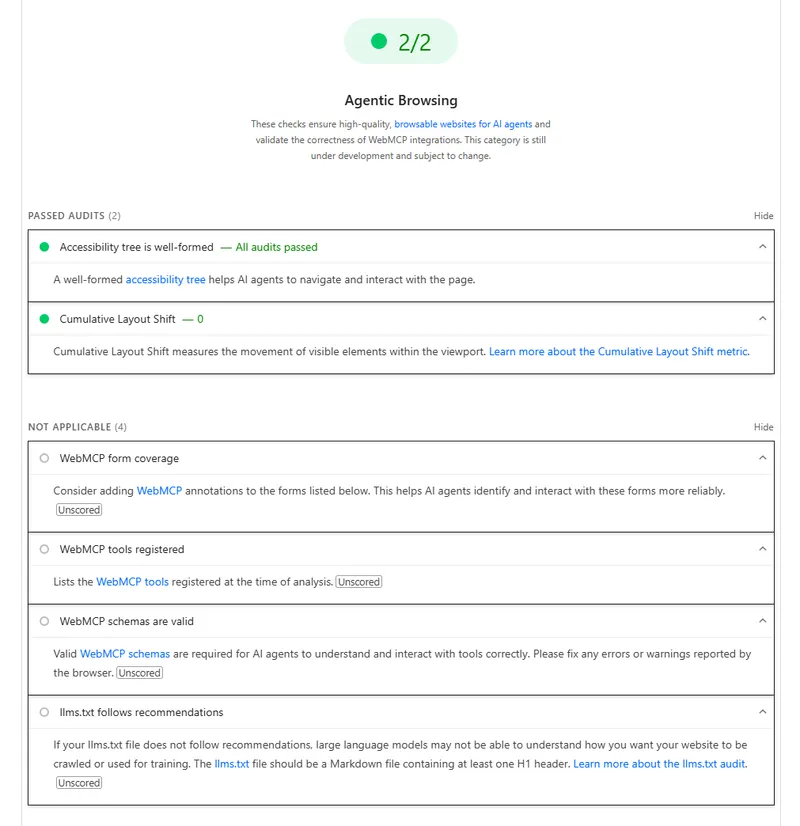
Google pays attention, among other things, to whether the page structure is readable by bots, whether the layout remains stable while loading, and whether the page has a simple AI-facing summary. It also checks for a new feature: whether the site provides agents with specific tools to perform their tasks.
Ready-to-use tools for AI agents - WebMCP
A new standard called WebMCP is being developed jointly by Google and Microsoft. It allows you to label a form on a webpage so that an AI agent knows exactly what a given field means and how to use it, rather than having to guess based on the button’s appearance. The standard is still in its early stages, but it clearly points to the direction in which web design for AI bots is heading.
Structured data isn't just for SEO
Facts about your offer, prices, or availability should be recorded in a clear, standardized format, not just as text in a paragraph. This way, the agent won't have to interpret the text but can simply read the data as-is.
A well-organized code structure
These principles have long been central to digital accessibility for screen reader users. Well-labeled buttons, forms, and headings make it easier for people with disabilities to navigate websites. This also improves how bots read content, as they no longer have to guess what elements are present.
Many of these changes can be implemented without major overhauls. However, it’s worth starting with a comprehensive audit and considering a modern platform - Astro, Sanity, or Cloudflare. Now is a good time to build a website that will stand the test of time.