We accept USD, EUR, PLN and 19 other currencies
Seamless communication in English and Polish
We always meet deadlines - no more dragging projects

Custom platform for selling and managing training courses

Bonapi: its own training platform, less manual work and lower IT costs

Bonapi needed simpler training administration and the freedom to develop services for its customers. We built a custom platform for sales, online learning and enrolment management in Poland and the Netherlands. It replaced costly tools that did not fit, reduced the team's workload and made it possible to develop the features the company wants to stand out with.

/ Project facts

Client

Bonapi

Industry

Technologies

React Spring Boot Sanity Cloudflare Java PostgreSQL Stripe Tailwind

Scope of work

process and offer model analysis course catalogue and pricing rules admin panel learner and company portal online courses and exams payments and VAT handling exam provider integration CRM integration multi-market support ongoing development and maintenance

Results

  • 62 %

    growth in online enrolment share

  • 57 %

    lower team workload

  • ⅓

    of previous IT maintenance costs

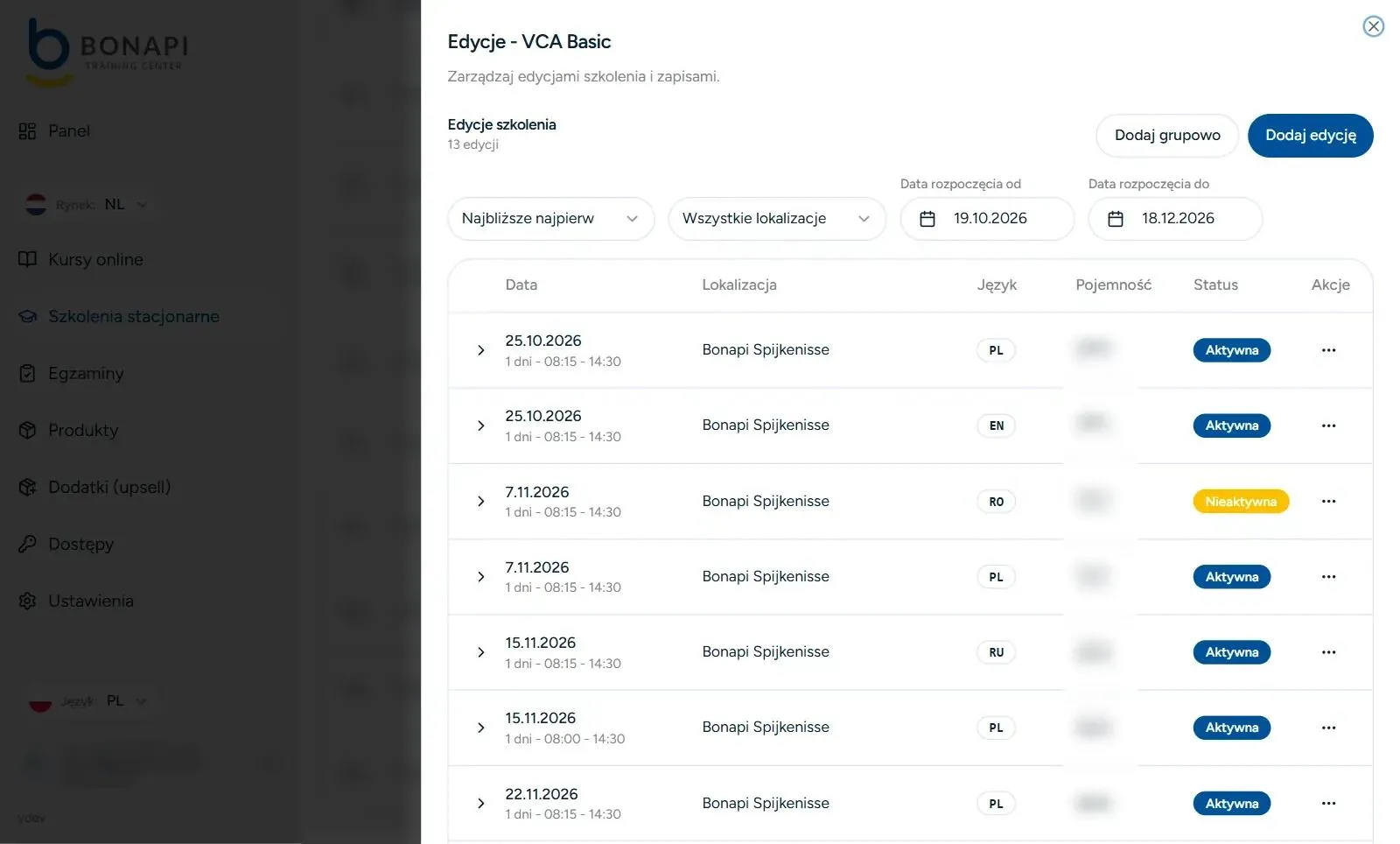
List of VCA Basic training dates in the Bonapi admin panel, with language, location and the number of enrolled participants.
The panel shows training dates and the number of seats taken, broken down by language and location.

/ 01 problems and challenges

Costly systems made it hard to run training and grow the offer

Bonapi runs classroom training, online courses and exams in many languages, for individuals and companies. It used an extensive training management system, and its online courses ran on separate WordPress installations. The company used a small part of what the off-the-shelf system could do, but paid to maintain the whole tool. At the same time it lacked features that matched the way it works.

Running training took a lot of manual work. Staff moved data between tools, handled enrolments and sorted out errors. An awkward interface made daily work harder for the team, and buying and enrolling harder for customers. This led to delays, extra costs and lost sales. Bonapi needed simpler order handling, automation of repetitive tasks and a solution ready for its planned operations in Poland.

Standing out on the market was another important goal. The company wanted to develop services that make it easier for learners and employers to organise training and encourage them to keep working with Bonapi. A platform of its own was to give it the freedom to introduce such features without depending on what off-the-shelf software can do or plans to do.

What had to be solved

  • Simplify buying training and reduce manual work, errors and delays in handling it.
  • Lower tool maintenance costs and bring both markets together on one platform.
  • Make room for Bonapi's own services for learners and companies that set its offer apart.

/ 02 our process

A system designed around how Bonapi works and what its customers need

At first we planned to connect Bonapi's new websites to its existing training management system. Conversations about day-to-day work showed, however, that integration alone would leave the team with many of the same difficulties. They would still have to use a tool that did not fit, maintain scattered online courses and bend new ideas to the limits of those systems.

We proposed building a custom web application. The analysis covered how the offer is put together, how a purchase runs, how participants are handled and what companies ordering training for their employees need. On that basis we planned the catalogue, orders, the admin panel and the user portal. Further features were developed after sales had started.

We also decided that the platform should be where customers are looked after once they have bought. The learner gets access to their courses and study materials, and the employer can check their employees' training. This is the basis for further services that make things easier for customers and support their long-term relationship with Bonapi.

An offer that matches how training is sold

Bonapi sells online courses, classroom training and exams separately or in packages. We mirrored that structure in the catalogue: each item has its own data and can then be combined into different products. For example, the VCA Basic exam appears in four packages, but its dates are managed in one place.

Prices can be set by language and location. The platform also supports add-ons charged per participant or per order line. The team manages these settings in the admin panel, and the buyer sees the price of their option on the website.

Less work on schedules and enrolments

For planning recurring training we built a date generator. A staff member sets the period, weekdays, languages and locations, the hours and the number of seats, and checks the prepared series before saving it. This way they can plan the coming months of classes without adding each date separately.
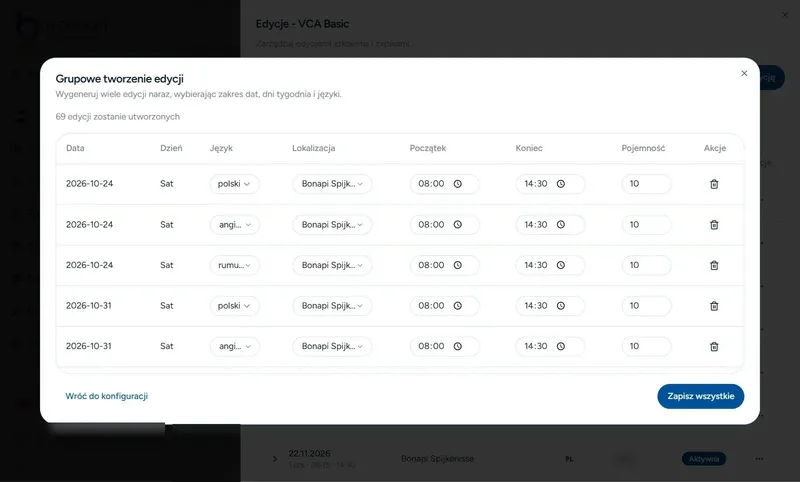
Preview of a series of dates in the Bonapi admin panel: dates, weekdays, languages, hours and seat limits before saving.

A schedule of recurring training can be prepared for several language versions at once.

The Bonapi websites fetch dates and seat availability from the platform. The system closes enrolment in advance, as set for each offer. It also takes already enrolled participants into account when the seat limit changes, which reduces the risk of errors when the schedule is updated.

Purchase connected with participant handling

We connected the purchase process on the website with orders and enrolments in the platform. The customer chooses an offer, enters the participants and pays online. Before payment the system checks seat availability and the enrolment conditions. Once payment is confirmed, it assigns each person a seat at the training or exam, or access to the online course.

Integrations take care of the next steps: Stripe issues the invoice, buyer and order data go to Zoho CRM, and buying an exam at an external centre triggers a booking in Pontifex. As a result, staff do not have to move data from every order between these tools by hand.

The office still has a role in handling unusual situations. The platform reports problems, such as a failed exam booking or a disputed payment, so the team can take the right action.

Online courses in a shared portal

Courses that used to run on separate LearnDash installations are now available on the shared platform. Participants use lessons, quizzes and final exams in their account, on a phone as well. After the exam they see the score and the pass mark, and the history shows their earlier attempts.

The Bonapi team updates lesson content in Sanity, split by market and language. It can set how long course access lasts and, if needed, grant it by hand. This ties online learning to sales and participant handling.

Serving companies that buy training for their employees

In a company purchase, the person placing the order and the participant are often different people. We built this into the process: a company can buy training for several employees in one order and name the participants for each line. The platform assigns them the right seats and access. If an employee does not have an account yet, the course bought for them is linked to their account once they register with the address given in the order.

In the "My employees" view the company checks the courses and enrolments of specific people, with the language and the online access period. The list covers purchases in both the Dutch and the Polish market. This matters to Bonapi as it builds relationships with employers: the portal is meant to make organising training easier for them after the order too.
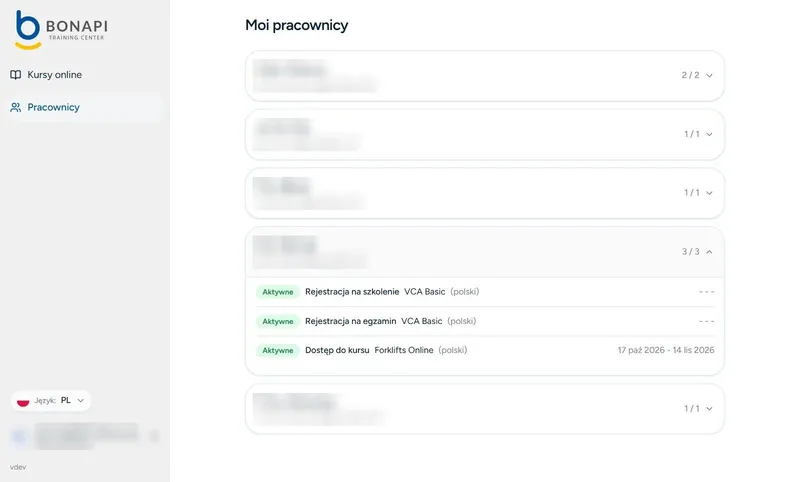
The My employees view in the Bonapi portal: a list of a company's employees and one person's training, exam and online course expanded.

The employer checks their employees' training and courses on one shared list.

Two markets served by the same application

We extended the platform to cover Bonapi's operations in Poland. Each market has its own offer, currency and Stripe account, and order notifications go to the right office. The team chooses the market in the admin panel. User accounts are shared, so a learner has access to courses from both countries in one portal.

Launching the Polish part did not require building a second application for orders and learning. We reused the existing features while keeping a separate offer and billing for each market. Both centres also benefit from further improvements developed in the shared system.
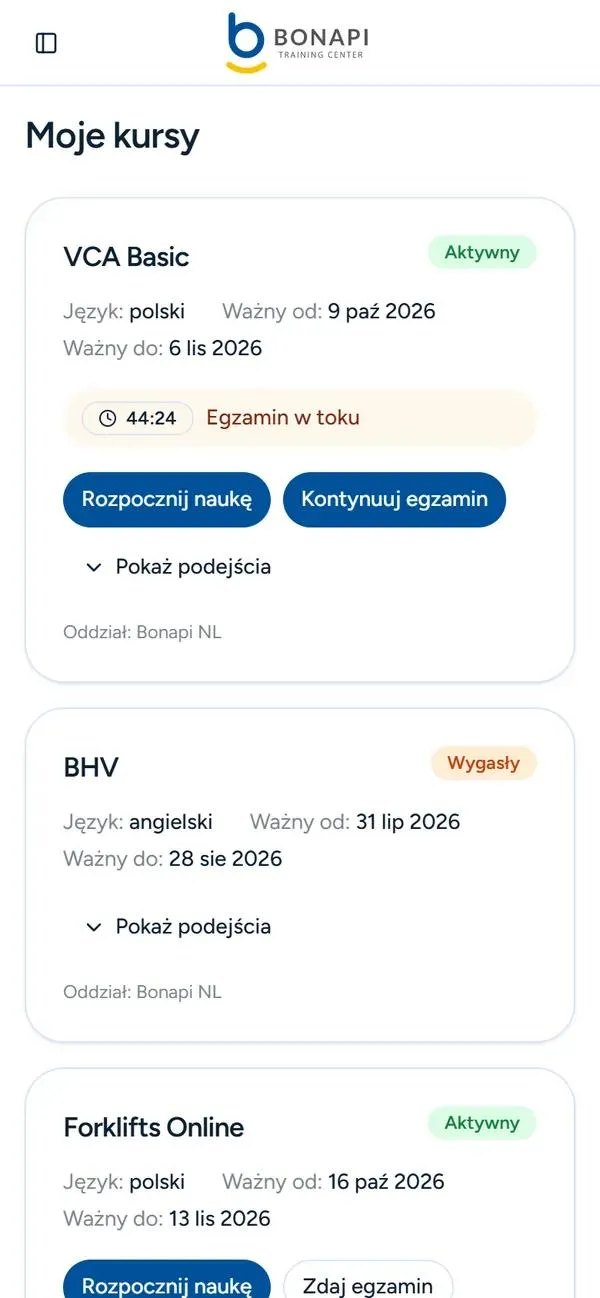
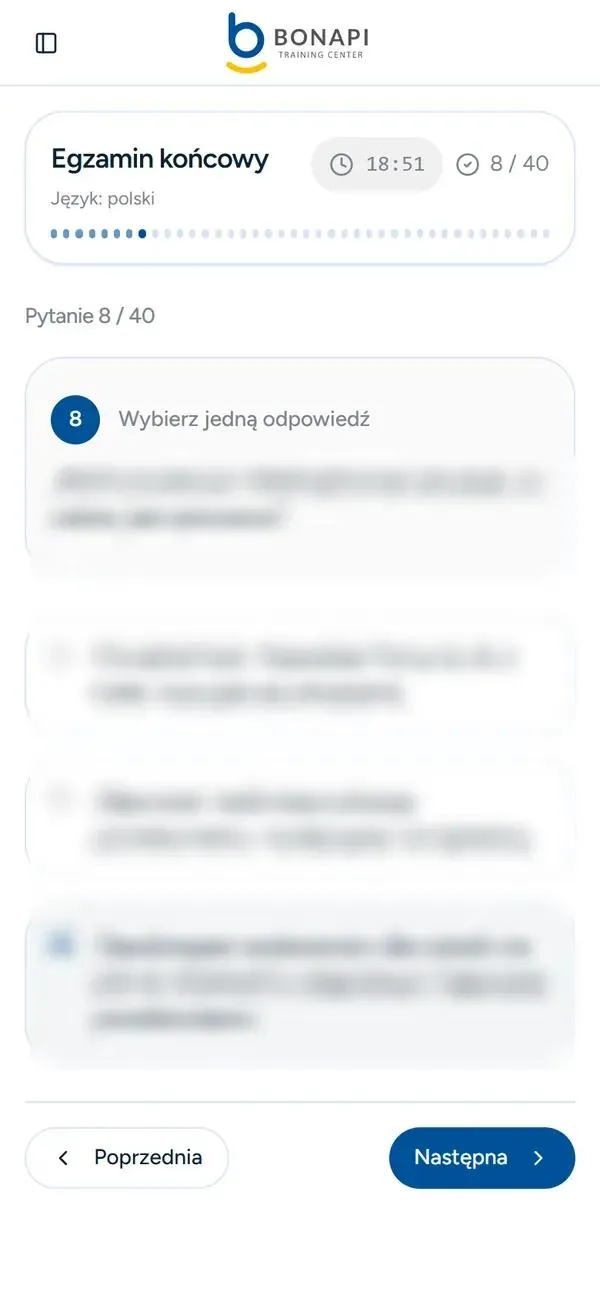
The course list, the exam and the result on the learner's phone.

My courses on a phone: an active course with an exam in progress, an expired course and a course from the other market.
01 The course list covers both markets and shows the access status and an exam in progress.
Final exam on a phone: a question with answers, a timer and exam progress.
02 The mobile exam view with the question, the answers and the time left.
Final exam result on a phone: percentage score, number of correct answers, pass mark and exam time.
03 The exam summary with the score and the pass mark.

/ 03 technology and integrations

Our own application, integrated with the services it needs

We built the admin panel and the user portal in React and TypeScript and deployed them on Cloudflare Workers. The catalogue, orders and training rules are handled by a backend in Spring Boot and Java. Data is processed in a PostgreSQL database.

For payments and invoices we use an integration with Stripe, Sanity holds part of the content, and sales data goes to Zoho CRM. We also built an integration with the API of exam systems in the Netherlands. This split lets Bonapi develop the way it runs training while using ready-made services where they meet its needs.

Data exchange between systems

Companies like Bonapi use many IT systems that support their growth and the way they serve customers. That is why we built the CRM and Stripe integrations with redundancy mechanisms. Our platform is the main source of data and keeps the information passed between systems consistent.

As a result, staff do not have to enter the same data several times or compare information across tools by hand. This means fewer mistakes and delays, and lets the teams focus on their work. The redundancy mechanisms make the integrations more resilient to temporary outages of the services involved, reducing the risk of breaks in the data exchange.

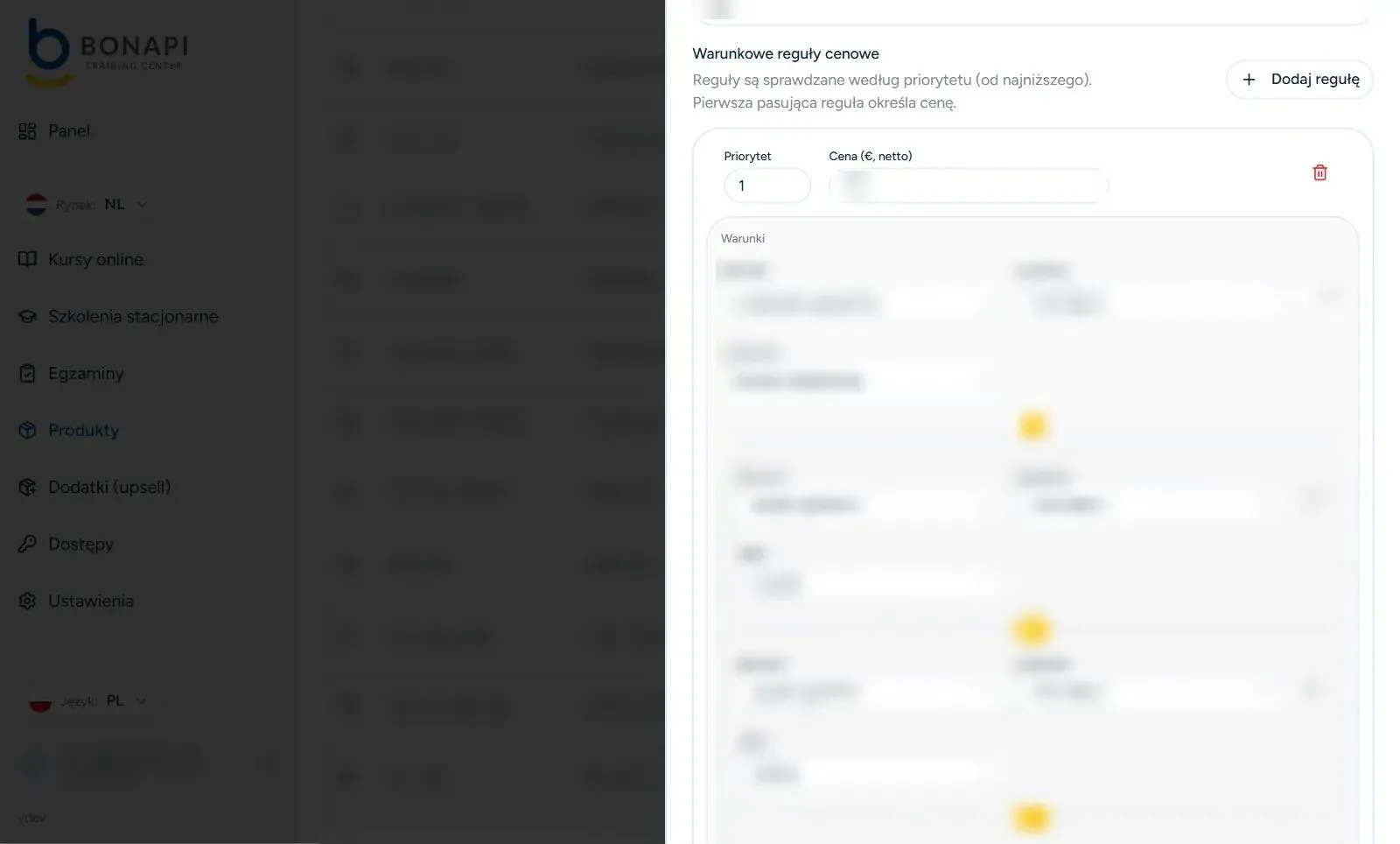
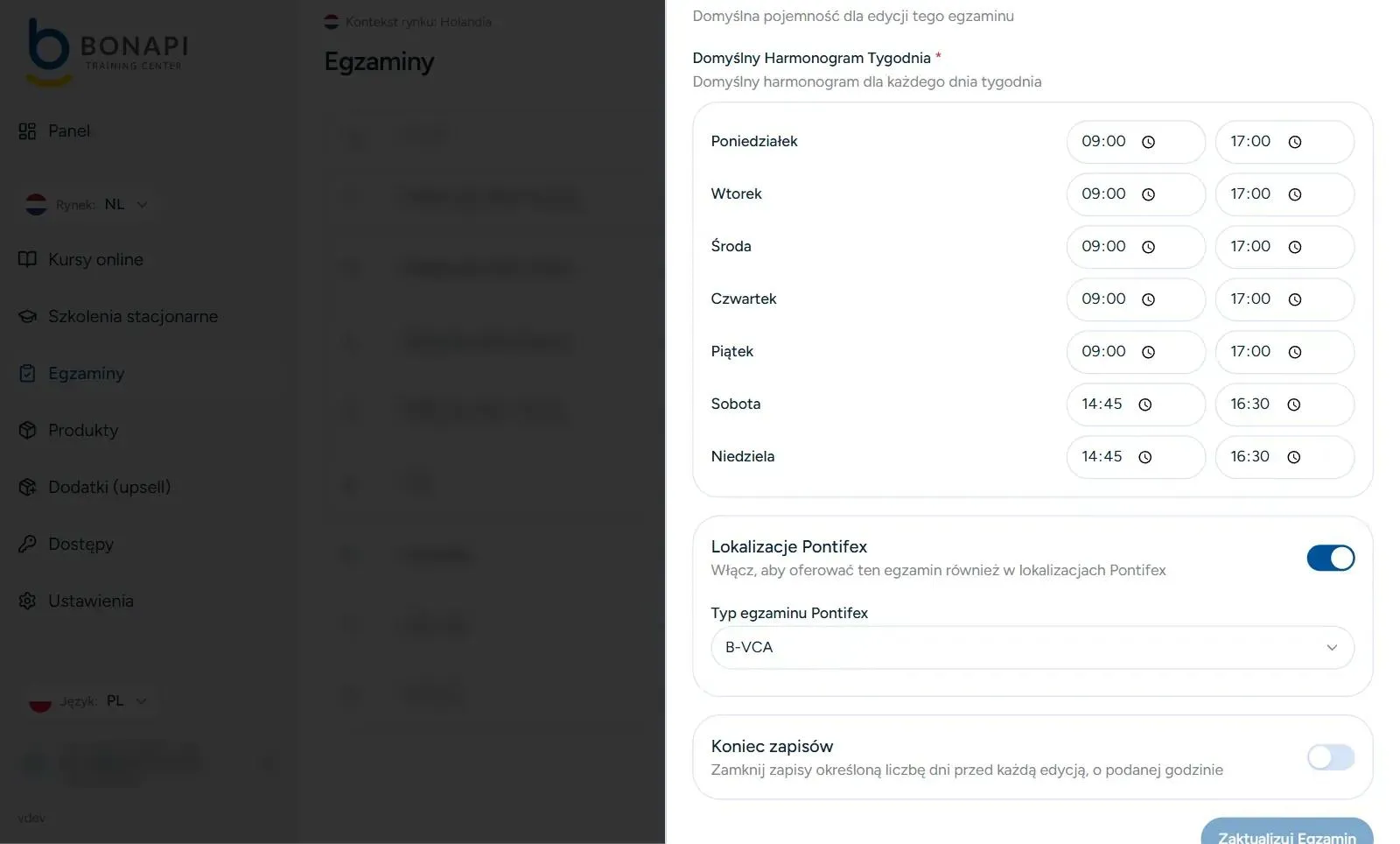
Managing prices and exam settings in the admin panel.

A pricing rule of the VCA Basic Online product in the Bonapi admin panel: exam location and the list of languages the price applies to.
04 The rule sets the price for the selected location and exam languages.
VCA Basic exam settings in the Bonapi admin panel: weekly schedule, the Pontifex locations switch with exam type and the enrolment deadline.
05 Exam settings cover the schedule, the enrolment deadline and the link to the Pontifex offer.

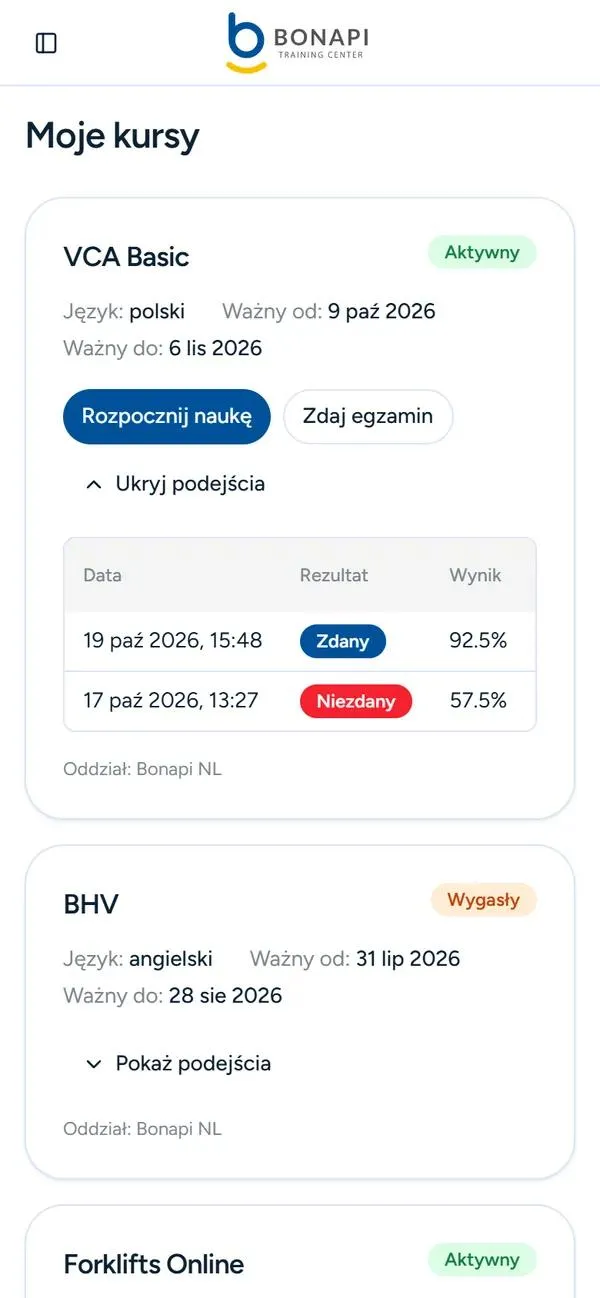
A course lesson and the history of exam attempts.

A VCA Basic course lesson in the Bonapi portal: chapter list with progress and lesson content with illustrations.
06 The lesson view with course content and navigation between chapters.
My courses on a phone: the expanded history of VCA Basic exam attempts, with a failed attempt and a later passed one.
07 The history of attempts with the result of each exam.

/ the platform in numbers

  • 62 % growth in online enrolment share

    share of online enrolments before the platform

    before launch vs April-October 2026
    Source: GA4, Meta Ads and Bonapi data

  • 57 % lower team workload

    team workload before the platform

    before launch vs April-October 2026
    Source: Bonapi data

  • ⅓ of previous IT maintenance costs

    maintenance costs of the previous systems

    before launch vs April-October 2026
    Source: Bonapi data

After the launch, the share of enrolments made online grew, the team's workload went down and IT system maintenance costs fell to a third of their previous level. The changes covered both how training is bought and how it is handled afterwards: the customer can place an order on their own, and the platform connects the payment with the participant's enrolment and passes the data on to the other tools.

Bonapi has also gained the ability to develop its own services for learners and employers. The portal is the basis for further work on customer convenience and on long-term relationships with companies that order training.

We compare the period before the platform with the period from the first sale in April 2026 to October 2026. We calculated the share of online enrolments from conversion and traffic data in GA4 and the Meta ad platform, together with Bonapi's internal data on all enrolments. Team workload and IT maintenance costs come from Bonapi's internal data.

About the Client

Industry: Education
Location: Spijkenisse, the Netherlands and Gliwice, Poland
Company Size:
Founded: 2018

Bonapi runs vocational and workplace safety training for individuals, companies and staffing agencies. The company was founded in the Netherlands in 2018. It offers classes in many languages, meeting the needs of workers from different countries.

At its centre in Spijkenisse near Rotterdam it runs VCA training, scaffolding courses and forklift and aerial platform classes, among others. In 2026 it opened a centre in Gliwice, with an offer that includes health and safety training and courses preparing for UDT licences. It also trains at clients' premises and offers online learning.

A platform that grows with Bonapi's offer

After sales started, we kept working together as part of ongoing support. Since then the system has gained order add-ons, further billing features and enrolment deadline settings, among other things. We also extended it to the Polish market.

Further development is meant to support both the team's work and the way customers use Bonapi's services. The company can decide which features will be useful to learners and employers and then roll them out on its own platform. That lets it build an offer that also stands out for how easy it is to organise training and get support afterwards.

The websites through which customers discover the offer and place orders are described in a separate case study of bonapi.nl and bonapi.pl.

/ questions

Questions about a custom training platform

A platform of your own is worth considering when the available tools make it hard to run your offer, require a lot of manual work or limit the services you can develop for customers. At Bonapi the cost of an extensive system, of which the company used only a small part, also mattered. We tailored the custom application to how training is sold, how the team works and what learners and employers need.

Yes. In the Bonapi platform we connected the sale of these services with participant handling and access to online learning. Courses, training and exams can be offered separately or in packages, with language, location and date taken into account. The team manages the offer in one shared panel, and the order defines the seats and access assigned to each participant.

Automation means connecting the purchase with the tasks that follow payment. At Bonapi the platform checks seat availability and, once the order is paid, enrols the participants or gives them access to online courses. Integrations take care of the invoice, the data sent to the CRM and the exam booking at an external centre. The system notifies the office of situations that need action.

Yes, the scope of integration depends on what your tools can do and on the API they offer. At Bonapi we connected the platform with Zoho CRM, Stripe and the Pontifex exam system. Order and participant data move between the systems without staff having to enter it again. In other projects we choose integrations to suit the tools a company already uses.

The system should tell apart the person placing the order, the company making the purchase and the training participants. At Bonapi an employer can enrol several people in one order, and the platform assigns each of them the right seats or courses. In the company portal the buyer checks employees' training and their online access periods.

Yes, although it depends on the cost of your current tools, the amount of manual work and the cost of building and developing the application. At Bonapi the platform reduced the team's workload and lowered IT system maintenance costs. When assessing whether a similar project pays off, you need to account for both ongoing savings and the investment in building the platform.

A system of your own lets you develop services that meet customers' needs, also after they buy training. At Bonapi learners use a shared portal for studying, and employers can see information about their employees' training. The platform can be extended with features that make organising training and using other services easier. For Bonapi this is one of the ways to build long-term relationships with customers.

So, shall
we begin?

Book a meeting